
Achieving Independence from Long-Term Pain Relief Treatments: A 2-Step Approach
Is it possible to be independent from long term regular body pain relief treatments?In the body-related pain relief industry, it is widely accepted—by both service providers and those receiving treatment—that people with chronic body pain will require ongoing, regular treatments to maintain relief. This belief has shaped how most long-term pain relief solutions are designed.As a result, the majority of service providers do not truly address the root causes of pain. Instead, they focus on managing symptoms. While this symptoms-focused approach plays an important role in helping individuals continue their daily routines without disruption, relying on it long-term creates dependency rather than resolution.Symptoms-Focused Pain Relief: Useful, But IncompleteThere are many ways to manage body-related pain without causing long-term harm. These include:
-Physiotherapy
-Chiropractic / bone adjustments
-Manual / massage therapy
-Traditional Chinese medicine
-Energy-based methods (lifeforce, chi, prana, reiki, qigong, etc.)
-Vibrational therapies (heat, electrotherapy, ultrasound, brainwave, etc.)These approaches aim to restore the body to a natural, pain-free state without relying on synthetic drugs or invasive procedures.From this perspective, if you are using a symptoms-focused approach, it is best to avoid methods that rely on synthetic drugs or invasive surgeries, and instead focus on restoring the body naturally.However, even with these safer approaches, they still primarily address symptoms—not the root causes. This is why many people struggle to achieve sustainable pain relief and instead find themselves needing continuous treatment.Can You Be Independent From Long-Term Pain Relief Treatments?Yes—definitely.In fact, achieving independence from long-term reliance on treatments is simpler than most people think. It comes down to just 2 essential steps:1. Break The Chronic Pain Cycle

2. Address Pain Recurrence

These two steps form the foundation of The OmniEase Method, designed to help reduce dependence on pain treatment by addressing both symptoms and root causes.Step 1: Break The Chronic Pain CycleTo effectively break the chronic pain cycle, three key components must be addressed:1a. Chronic Stress

Stress leads to tension in the body, which leads to pain. At the same time, pain increases tension, which further increases stress. This creates a continuous loop.Rather than trying to determine which comes first, the focus should be on managing stress practically.Simple ways to manage chronic stress include:
-Writing a short gratitude journal before sleep
-Turning mobile devices to airplane mode at night to reduce disruptions
-Staying properly hydrated throughout the dayBy reducing stress, you directly reduce physical tension—and therefore pain.1b. Breathing Pattern

Breathing plays a critical role in both stress and physical function.Poor breathing patterns—often caused by stress—can:
-Increase tension
-Overload secondary breathing muscles
-Affect postureWhen the diaphragm (the primary breathing muscle) is not used properly, muscles like the intercostals and latissimus dorsi compensate. This can tighten the chest and back, leading to poor posture and pain.Improving breathing helps:
-Reduce stress response
-Improve posture
-Support overall body functionKey areas to focus on:
-Proper diaphragm usage
-Breathing quality
-Breathing rate control1c. Posture / Body Alignment

Posture plays a major role in pain development and relief.There are two levels to improving posture:
1. Global posture improvement
-Aligning the body as a whole
-Produces significant improvements with minimal adjustments
-Examples: chiropractic adjustments, sensory-based alignment methods
2. Local posture improvement
-Targeting specific muscles or areas
-Examples: physiotherapy, massage therapyStarting with global alignment reduces the complexity of local corrections, making the process more effective and efficient.This directly connects to structural alignment and pain, a key factor in reducing chronic discomfort.Step 2: Address Pain RecurrenceBreaking the pain cycle is not enough. To prevent pain from returning, you must address the underlying factors that cause recurrence.2a. Movement Pattern

Movement is essential for long-term recovery and movement-based pain relief.Improving movement happens at three levels:
1. Improving mobility of individual body parts (head, shoulders, hips, etc.)
2. Improving integrated movements (walking, standing, exercising)
3. Improving muscle balance during these movementsBetter movement reduces strain, improves efficiency, and prevents recurring pain.2b. Energy (Lifeforce / Chi / Prana / Reiki / Qigong / etc.)

Energy influences how deeply rooted issues affect the body.Unresolved experiences—such as trauma, overwork, or poor adaptation—can reinforce:
-Stress
-Poor breathing
-Bad posture
-Inefficient movementAt a surface level, practices like traditional Chinese medicine and energy healing help regulate this flow.At a deeper level, psychological processing is needed to address root causes.This can be done through:
-Deep reflective journaling
-Meditation
-Art therapy
-Hypnosis
-Emotional counsellingA structured approach to processing includes:
1. Uncover
2. Acknowledge
3. Address
4. Reframe
5. Make peace / let go2c. Thought Coherence

Internal conflict within yourself can be a major source of stress—and therefore pain.When different parts of you hold conflicting:
-Goals
-Beliefs
-Strategies
-Perspectives
…it creates internal tension, which translates into physical tension.Some conflicts are conscious, while others are not.To uncover and resolve them:
-Use journaling, meditation, therapy, or similar methods
-Develop self-awarenessTo move toward internal coherence, ask:
-Do these viewpoints need to conflict?
-Can they support each other?
-Can they be aligned?
-Can I align with both at the same time?Reducing internal conflict reduces stress, which supports long-term pain reduction.Why Most People Stay Dependent on Treatments?By now, it becomes clear:
The 2 steps are simple—but not easy.Most mainstream providers (physiotherapists, chiropractors, massage therapists) focus only on part of:
1c. Posture / Body AlignmentEnergy-based methods often address symptoms of deeper issues—but not the root.At the same time, deeper solutions like psychological processing are:
-Not commonly linked to physical pain
-Not applied at the required level to resolve itThis gap explains why many people remain dependent on ongoing treatments instead of achieving sustainable pain relief.Moving Towards IndependenceIf you’ve been relying on regular treatments just to manage your pain, you can now see why.Following standard treatment protocols alone is often not enough to fully resolve chronic pain or reduce dependence on pain treatment.The good news is:
Guidance on all components of The OmniEase Method is available.The OmniEase Method
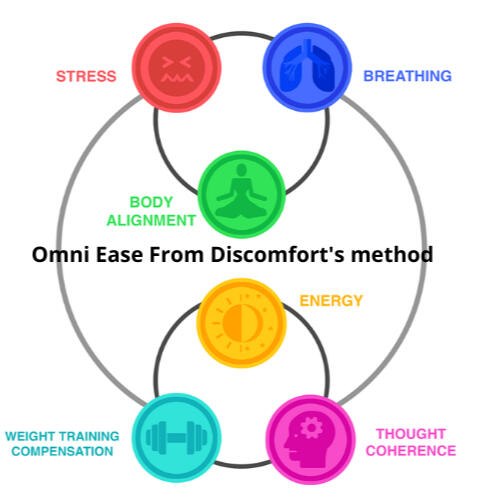
A glimpse of The OmniEase Method is available inside the Pain Relief Silver Membership Portal.Access to the Membership Portal is currently free for the first month, giving you the opportunity to start applying practical tips to better manage your pain and move towards reducing dependence on long-term pain relief treatments.To access the Membership Portal while this offer is available, click the button below now.